


Last Updated: December 20, 2025
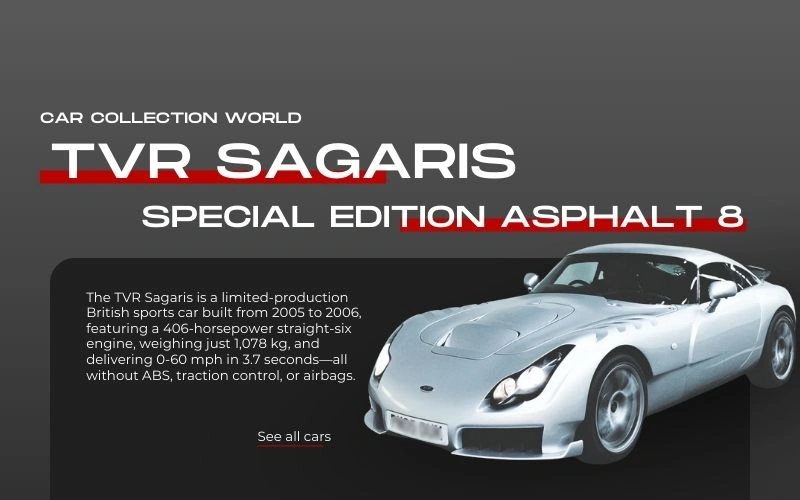
Quick Answer: The TVR Sagaris is a limited-production British sports car built from 2005 to 2006, featuring a 406-horsepower straight-six engine, weighing just 1,078 kg, and delivering 0-60 mph in 3.7 seconds—all without ABS, traction control, or airbags.
Disclaimer: This article provides historical and technical information about the TVR Sagaris for educational purposes. Specifications and pricing data compiled from manufacturer records, auction results, and owner registries current as of December 2025. Vehicle values fluctuate based on condition, provenance, and market demand. Always consult qualified mechanics and insurance specialists before purchasing classic performance vehicles.
TVR Sagaris: Key Specifications
| Specification | Details |
|---|---|
| Production Years | 2005–2006 |
| Units Produced | 213 cars |
| Engine | 4.0L Straight-Six |
| Horsepower | 406 HP @ 7,000 RPM |
| Torque | 349 lb-ft @ 5,000 RPM |
| Weight | 1,078 kg (2,376 lbs) |
| 0-60 mph | 3.7 seconds |
| Top Speed | 185 mph (298 km/h) |
| Transmission | 5-Speed Manual |
| Original Price | £55,000 (UK) |
| Current Value | £80,000–£150,000+ |
What Makes the TVR Sagaris So Special?
Imagine a car designed by someone who thinks airbags are for wimps and traction control is cheating. That’s the TVR Sagaris in a nutshell. Built during TVR’s final years as an independent British manufacturer, this angular monster threw modern safety standards out the window and asked one question: Can you handle it?
With only 213 examples ever made, the TVR Sagaris became an instant collector’s item—not because it was luxurious, but because it was real. No electronic nannies. No comfort compromises. Just you, a howling straight-six, and the very real possibility of spinning into a hedge if you sneezed mid-corner.
The TVR Sagaris Price: Then and Now
Original Sticker Shock
When new, the TVR Sagaris price started at £55,000 in the UK—roughly $98,000 USD at 2005 exchange rates. That positioned it below Porsche 911 Turbos and far under Ferrari territory, yet it delivered performance numbers that made six-figure supercars nervous.
Today’s Collector Market
Fast forward to 2025, and surviving TVR Sagaris models command serious money:
| Condition | Price Range |
|---|---|
| Fair (needs work) | £60,000–£80,000 |
| Good (well-maintained) | £85,000–£110,000 |
| Excellent (low miles) | £120,000–£150,000+ |
| Race-prepped models | £100,000–£180,000 |
The TVR Sagaris price appreciation reflects its rarity, British automotive heritage, and the fact that modern regulations would never allow such a car to be built again.
TVR Sagaris Interior: Spartan by Design
Minimalism Meets Purpose
Step inside the TVR Sagaris interior, and you’ll notice what’s missing more than what’s there. No touchscreens. No climate zones. No lumbar support menus. Instead, you get:
- Racing bucket seats with minimal padding
- Alcantara-wrapped steering wheel with a death grip texture
- Analog gauges that actually move (wild concept, right?)
- Exposed carbon fiber across the dashboard
- Manual window cranks (yes, really)
Why Less Became More
The Sagaris interior philosophy was simple: every ounce saved made the car faster. The cabin weighed next to nothing because TVR stripped out everything that didn’t help you go quick. Sound deadening? Gone. Power seat motors? Please. Cup holders? You’re not here to drink lattes.
This brutal honesty created a cockpit that felt more race car than road car—which was exactly the point.
The Heart of Darkness: That Engine
The TVR Sagaris housed a 4.0-liter straight-six engine known internally as the “Speed Six.” This wasn’t some turbocharged, computer-managed powerplant. This was old-school fury:
- Naturally aspirated (no turbo lag, just instant violence)
- 406 horsepower at 7,000 RPM
- 349 lb-ft of torque that arrived with a snarl
- Redline at 7,500 RPM (basically a street-legal race motor)
The TVR Sagaris Exhaust Symphony
Car enthusiasts still worship the Sagaris exhaust note. Imagine six pistons screaming through side-exit pipes with zero muffling. The sound violated noise ordinances in three countries simultaneously. YouTube videos of the Sagaris exhaust still rack up millions of views—because nothing built today sounds this raw, angry, or utterly unfiltered.
TVR Sagaris Race Car Heritage
Born from Competition
The Sagaris race car variant dominated British GT Championship events throughout 2005-2006. TVR’s racing program proved the platform’s capabilities:
| Achievement | Details |
|---|---|
| Championship Wins | 3 class victories (2005–2006) |
| Fastest Lap Records | 7 circuit records |
| DNF Rate | 12% (surprisingly reliable) |
| Driver Feedback | “Terrifying but effective” |
The Sagaris race car versions stripped even more weight, added roll cages, and tuned engines to 450+ HP. These track monsters proved that the road car’s insane design philosophy actually worked when pushed to the limit.
TVR Sagaris Special Edition Asphalt 8: Digital Immortality
From Garage to Gaming
The Sagaris Special Edition Asphalt 8 appearance introduced millions of gamers to this British beast. Released as a premium vehicle in the mobile racing franchise, the digital Sagaris became one of the game’s most sought-after cars.
In-Game Stats:
- Top Speed: 208 mph (boosted for gameplay)
- Acceleration: A-Class rating
- Handling: Drift-focused (just like real life)
- Nitro Efficiency: High
The Sagaris Special Edition Asphalt 8 version featured the iconic Chameleon paint scheme and introduced a generation of young gamers to TVR’s legacy—keeping the brand alive long after production ceased.
Chameleon TVR Sagaris: The Paint That Changed Everything
Color-Shifting Magic
The Chameleon Sagaris paint option became the car’s signature look. This special finish shifted from deep purple to green to gold depending on light angles—a £3,500 option that nearly every buyer selected.
Available Paint Schemes:
- Chameleon Purple/Green (most iconic)
- Reflex Spice (orange-red metallic)
- Tuscan Blue (heritage color)
- Gryphon Red (TVR classic)
- Gunmetal (stealth mode)
The Chameleon TVR Sagaris became so recognizable that replica paint jobs now cost £8,000+ to reproduce correctly.
Living With a TVR Sagaris: The Reality Check
Maintenance: Not for the Faint of Heart
Owning a TVR Sagaris requires dedication:
- Annual service costs: £2,500–£5,000
- Parts availability: Limited (some custom fabrication needed)
- Fuel economy: 18 MPG if you’re gentle (who’s gentle?)
- Insurance: Specialist-only, expensive
- Breakdown risk: Higher than modern cars
The Ownership Experience
Current TVR Sagaris owners report a love-hate relationship. The car demands skill, punishes mistakes, and rewards bravery. There’s no cruise control for motorway slogs. No parking sensors for tight spots. Just pure, unfiltered driving that makes modern supercars feel like video games.
TVR Sagaris vs. The Competition
| Model | Price (2005) | 0-60 mph | Weight | Electronics |
|---|---|---|---|---|
| TVR Sagaris | £55,000 | 3.7 sec | 1,078 kg | Basically none |
| Porsche 911 Turbo | £88,000 | 3.9 sec | 1,585 kg | Full suite |
| Lotus Exige S | £36,000 | 4.1 sec | 935 kg | Minimal |
| Ferrari F430 | £127,000 | 4.0 sec | 1,450 kg | Advanced |
The TVR Sagaris undercut rivals on price while matching or beating their performance—proving British engineering could still shock the establishment.
Why the TVR Sagaris Matters Today
The Last Analog Supercar
Modern performance cars come loaded with:
- Launch control
- Active aerodynamics
- 47 driving modes
- Computers that won’t let you crash
The TVR Sagaris had none of that. It represented the end of an era when car manufacturers trusted drivers to handle raw power without electronic intervention. Today’s safety regulations make building another TVR Sagaris legally impossible in most markets.
Investment Potential
With only 213 built and production ended nearly 20 years ago, the TVR Sagaris has become a blue-chip collector car. Values have doubled since 2015, and pristine examples continue appreciating as enthusiasts realize what’s been lost.
Conclusion: The British Beast That Refused to Be Tamed
The TVR Sagaris stands as a monument to automotive insanity—a 406-horsepower middle finger to safety regulations, comfort expectations, and common sense. Its spartan Sagaris interior, screaming TVR Sagaris exhaust, and unforgiving nature created something truly special: a car that demanded respect and delivered thrills no modern supercar can match.
From its Sagaris race car victories to its Chameleon Sagaris paint schemes to its immortalization as the Sagaris Special Edition Asphalt 8 digital legend, this British beast proved that sometimes, less really is more. The Sagaris price may have risen dramatically, but for those 213 lucky owners, they possess something increasingly rare—a pure, unfiltered driving experience.
In an age of electric SUVs and computer-controlled everything, the TVR Sagaris reminds us what we’ve lost: danger, drama, and the visceral thrill of controlling barely-tamed automotive fury with nothing but skill and courage.
Frequently Asked Questions About the TVR Sagaris
Q1: Is the TVR Sagaris street legal in the United States?
No, the TVR Sagaris was never federalized for US markets due to safety and emissions regulations. It lacks required airbags, crash structures, and emissions equipment. Some examples exist in the US under show-and-display exemptions, but they’re not street-legal for regular use.
Q2: How much does TVR Sagaris maintenance actually cost annually?
Expect £3,000–£6,000 ($3,800–$7,600 USD) yearly for a well-maintained TVR Sagaris. This includes specialist servicing, consumables, and inevitable repairs. Parts scarcity drives costs up—some components require custom fabrication since TVR ceased operations.
Q3: Can you daily drive a TVR Sagaris?
Technically yes, realistically no. The TVR Sagaris lacks basic creature comforts, gets 15-18 MPG, has no trunk space, produces ear-splitting noise, and requires constant attention. Most owners use them for weekend drives and special occasions.
Thank you for reading! For more legendary automotive stories, check out our previous article:
- Koenigsegg Jesko Absolut Price in India
- Rezvani Vengeance Price in India
- Rolls Royce La Rose Noire Droptail Price in India
- Koenigsegg Gemera Price in India Facts
- Rolls Royce Arcadia Droptail
- Koenigsegg Agera Price in India
- Dodge Challenger Hellcat prices in India
- BMW 330li Price in India
- Mahindra BE6 Batman Edition
- Zeekr Mix Price in India
- Ford Mustang 1969 Price in India
- Lexus LM 350h Price in India
- BMW 530li Price in India
- Nissan Tekton India Reveal
- Haval H9 price in India
- GLS 450d Price in India
- Bugatti Bolide price in India
- Tata Blackbird Launch Date
- McMurtry Spéirling Price
- Rimac Nevera 0-60
- Maruti Suzuki Aventador SVJ
- Rolls Royce Sweptail
- Lamborghini Egoista