

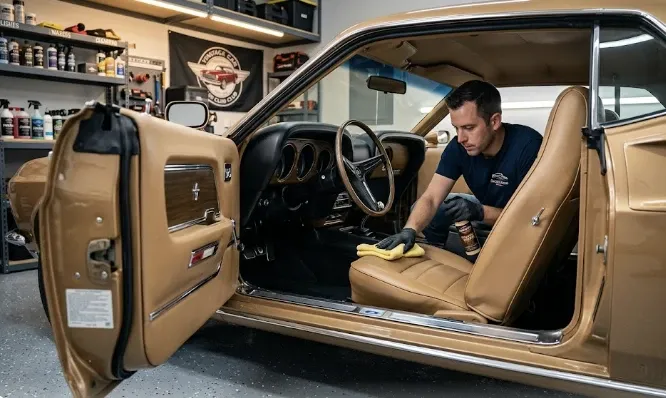
Anyone who has spent time around serious car collectors knows they operate by a different set of standards. A collector who keeps a 1967 Mustang fastback in concours condition doesn’t just wash the exterior and call it done. The interior gets the same level of attention — sometimes more. Stitching is inspected. Leather is conditioned on a schedule. Fabric headliners are protected against UV. The ethos is simple: the thing you’ve invested in deserves the maintenance that preserves its value.
What’s interesting is how rarely that mindset transfers from the garage to the living room. The same person who would never let their classic car’s leather seats crack from neglect will leave a fabric sofa in the living room uncleaned for three years and think nothing of it. The investment in home furniture is often comparable — sometimes greater — yet the standard of care applied is almost always lower.
There’s a lot that the collector’s approach to automotive upholstery can teach the average homeowner about caring for the fabric and leather pieces they live with every day.
The Collector Principle: Know Your Material
One of the first things any serious collector learns is that material knowledge is non-negotiable. You cannot care for automotive upholstery properly without understanding exactly what it’s made of. Aniline leather responds differently to cleaning than semi-aniline or pigmented leather. Wool broadcloth — common in British and European classics — requires completely different handling than vinyl or modern synthetic fabrics.
This principle transfers directly to home furniture, and it’s where most homeowners go wrong first. A sofa tagged with an “S” cleaning code (solvent only) should never have water-based products applied to it — yet it happens constantly, because the owner either didn’t check or didn’t know what the code meant. A velvet accent chair requires different treatment than a polyester blend. A natural linen sofa reacts differently to moisture than a microfiber sectional.
The collector’s habit of reading documentation, checking specifications, and understanding material properties before taking any action is exactly the discipline that prevents expensive cleaning mistakes at home. Before anything else: know what you’re working with.
Scheduled Maintenance vs. Reactive Cleaning
In the collector world, maintenance happens on a schedule — not in response to visible problems. A collector doesn’t wait for the leather to crack before conditioning it. They condition it every few months regardless of how it looks, because they understand that by the time visible deterioration appears, significant damage has already occurred beneath the surface.
Home upholstery works the same way, and most owners approach it entirely backwards. The standard approach is reactive: clean the sofa when there’s a visible stain, or when it starts to smell, or when guests are coming. By that point, the fabric has already accumulated months or years of embedded soil, oils, and allergens that surface-level spot cleaning cannot address.
The collector’s approach — scheduled, preventive, consistent — produces dramatically better long-term results. For most home upholstery in regular use, this means:
- Weekly vacuuming with an upholstery attachment to remove surface debris before it embeds
- Immediate spot treatment of any spill or stain using the correct method for the fabric type
- Professional deep cleaning every 12 to 18 months, regardless of visible condition
- Leather conditioning every 3 to 6 months if any leather pieces are in use
The professional cleaning interval is the one most frequently skipped, because the furniture doesn’t look dirty. But as any collector will tell you, “looks fine” and “is fine” are two very different assessments.
The Right Tools for the Right Material
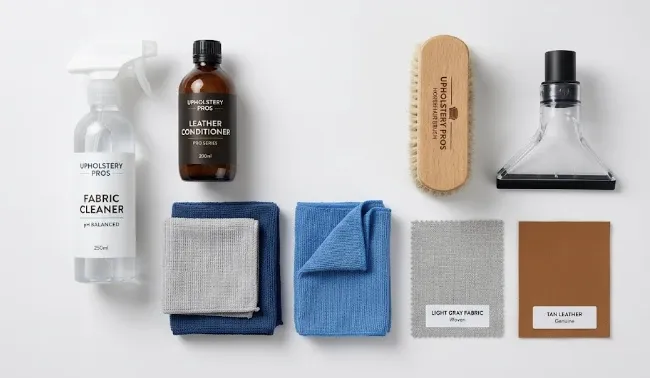
Serious collectors don’t clean their interiors with generic household products. They use pH-balanced leather conditioners formulated for the specific type of leather. They use fabric-safe cleaners tested for colorfastness. They use brushes with the correct bristle stiffness for each surface. The tools match the material.
The equivalent failure mode in home upholstery care is reaching for whatever cleaning product is under the sink and applying it to whatever fabric needs attention. This is how permanent damage happens. Some all-purpose cleaners leave residue that attracts more dirt. Some contain bleaching agents that affect dye. Some are too alkaline for natural fibers.
Professional upholstery cleaning services bring material-specific products and equipment to every job — the same principle collectors apply in the garage. They carry different cleaning solutions for fabric types, different approaches for leather versus synthetic materials, and the equipment to extract cleaning solution completely rather than leaving residue behind.
Storage, Protection, and the Long Game
Collectors think in decades. A car that’s properly maintained today is one that will be significantly more valuable — and more enjoyable — in twenty years. The same long-game thinking applies to quality home furniture, even if the ownership horizon is shorter.
A sofa that receives regular professional cleaning and proper care between cleanings will last significantly longer than one that’s neglected. The fibers break down less quickly. Stains don’t have the opportunity to set permanently. The structural integrity of the upholstery is preserved. For pieces with real quality — the kind of furniture worth investing in — the maintenance cost over time is almost always justified by the extended lifespan and preserved aesthetic quality.
Fabric protectors, applied after professional cleaning, work similarly to the ceramic coatings and paint protection films that collectors apply to their cars: they create a barrier that makes future cleaning easier and gives the material more resistance to the everyday use that would otherwise degrade it faster.
When to Call a Professional — and How to Find a Good One
Collectors know there are things they can handle themselves and things that require a specialist. Interior restoration on a valuable classic goes to someone who has done it before, has the right tools, and can be held accountable for the result. The same judgment applies to upholstery cleaning.
Routine vacuuming and immediate spot treatment are owner responsibilities. But deep extraction cleaning, leather reconditioning, stain removal from delicate fabrics, and treatment of significant soiling are professional territory. Attempting professional-grade work with consumer products and without professional equipment produces professional-grade disappointment most of the time.
Finding a good upholstery cleaning service follows the same logic as finding any quality specialist: look for demonstrated expertise in the specific material type, transparent pricing, and a genuine satisfaction guarantee. For homeowners in the greater Seattle area, a reliable option for affordable upholstery cleaning in Lynnwood WA covers all of these bases — pre-cleaning fabric assessment, clear upfront pricing, and a guarantee that means the job gets done right or done again.
The Underlying Principle
The collector’s approach to automotive upholstery isn’t complicated. It’s consistent, it’s material-specific, and it’s built on the understanding that preservation is always cheaper than restoration. What you protect today doesn’t need to be repaired tomorrow.
That principle doesn’t change when you move from the garage to the living room. The furniture you own is worth caring for with the same discipline. Know your materials. Maintain on a schedule. Use the right products. Call a professional when the job exceeds what consumer tools can accomplish.
The collectors got there first. Homeowners who adopt the same mindset end up with the same results: pieces that hold their quality for years longer than anyone expected.
